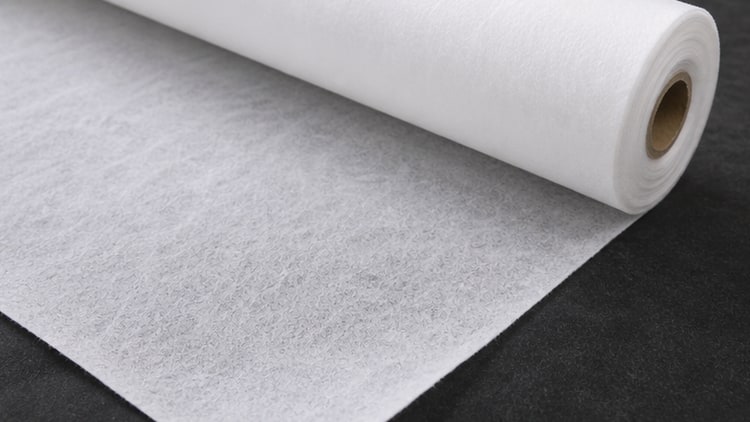
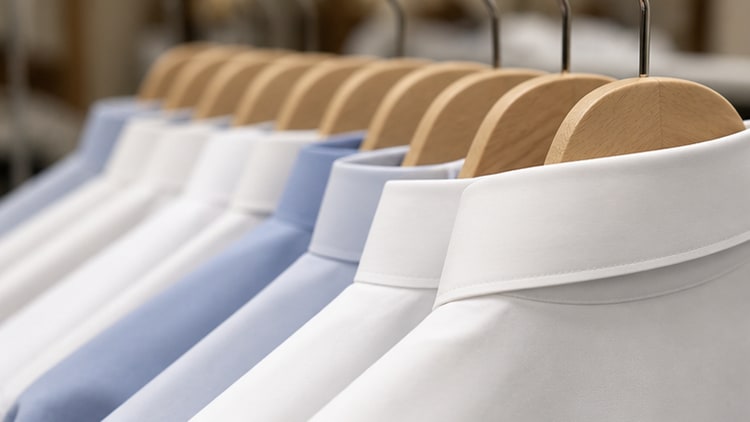
The collar and cuffs of a shirt are folded and rubbed more often than most garment parts. If the interlining does not match the shell fabric, collar points can curl, cuffs may feel weak, and fusible delamination can appear after washing. This guide summarizes practical criteria to check before selecting collar interlining and cuff interliningfor shirt production.
Why shirt collar and cuff interlining should be selected separately
Interlining for the body and interlining for collars and cuffs have different requirements. The body needs overall comfort and silhouette control, while collars and cuffs must provide shape stability, recovery and wash durability within a small area. For dress shirts, uniform shirts and workwear shirts that are worn and washed repeatedly, problems can appear after bulk production even when the first sample looks acceptable.
For that reason, shirt interlining should not be chosen only by thickness or stiffness. It should be matched with the shell fabric thickness, weave, finishing condition and production press equipment.
Selecting interlining strength by fabric thickness and weave
For thin cotton, TC and polyester-blend shirt fabrics, an overly heavy interlining can show through the surface or make seams feel too rigid. For oxford, twill and heavier uniform fabrics, a very soft interlining may cause the collar to collapse and the cuff edge to curl.
Interlining strength is difficult to judge by hand feel alone. After fusing it to the fabric, sew it into an actual collar shape and check whether it keeps its form after turning, steaming and pressing. If you need related materials, the fusible interlining product pageprovides basic applications and consultation points.
How to choose between fusible interlining and woven interlining
Fusible interlining is widely used for shirt collars and cuffs because it supports efficient work and consistent shaping. However, premium shirts, heavier fabrics and styles that need stronger recovery may require woven interlining as well. Woven interlining can move more naturally with the fabric and help maintain a refined shape.
Use these criteria when comparing options. First, if the shell fabric is thin or semi-transparent, check whether adhesive dots or interlining color show through. Second, when washing is frequent, prioritize adhesion and shrinkage stability. Third, if the collar should not stand like a board, start with an interlining that gives a softer hand feel. When woven reinforcement is needed, the woven interlining product pageis also useful for reference.
Temperature, pressure and time determine shape stability
Even the same interlining can fail when press conditions are not correct. Low temperature or short dwell time can lead to delamination after washing, while excessive heat or pressure may cause fabric shine, shrinkage or press marks. Because collars and cuffs are highly visible after sewing, even small press marks can become a quality claim.
During sample testing, record temperature, pressure, dwell time and cooling time based on actual bulk-production equipment. This is especially important when production is split across overseas garment factories or Middle East apparel production programs, because different press machines can produce different results even with the same fusible interlining supplier.
How to prevent delamination and shrinkage after washing
Shirts are washed repeatedly. If adhesive lifting appears around collar edges, cuff fold lines or stitch areas, the finished garment looks much lower in quality. To prevent this, check not only the adhesion of the interlining itself but also fabric shrinkage, finishing residues and washing conditions.
Before bulk production, make fused test pieces with the fabric and interlining, then compare dimensional change, surface bubbles and edge peeling before and after washing. If the fabric shrinks while the interlining barely shrinks, or the opposite occurs, the collar may twist or pucker and the combination should be reviewed again.
Production conditions to confirm before sample approval
Interlining samples should be reviewed in finished form, not only as separate material pieces. Fuse and sew actual parts such as the collar band, collar point, cuff edge and buttonhole area. Even within shirts, dress shirts, uniforms and workwear have different stiffness and durability requirements.
When working with a new fabric or a tight delivery schedule, share the fabric swatch, application area, washing condition and desired hand feel. This helps an apparel interlining supplier recommend materials more accurately through a Korea and Vietnam textile material supply network for export-oriented material consultation in the GCC region, including UAE, Saudi Arabia and Qatar projects. For material consultation, the Lantor Bontex contact pageis available for fabric information and sample request details.
Practical checklist
- Have you checked the shell fabric thickness, weave and transparency first?
- Have you confirmed the required stiffness for the collar and cuffs in finished garment form?
- Have you recorded fusing conditions such as temperature, pressure, dwell time and cooling based on bulk equipment?
- Have you tested delamination, shrinkage, bubbling and fabric shine after washing?
- Have you checked curling, puckering and peeling at the collar point and cuff edge?
- Could the fabric color and interlining color create a show-through issue?
- Can the same result be reproduced at an overseas garment factory?
FAQ
Is a stiffer interlining always better for shirt collars?
No. The collar needs enough shape stability to avoid collapsing, but if the interlining is much stiffer than the fabric, the shirt can feel rigid and the seam area may look unnatural. It is safer to compare several sample levels according to fabric weight and shirt use.
Can cuffs use the same interlining as collars?
Sometimes they can, but it is not always the best answer. Cuffs move and rub around the wrist, so they may need more flexibility than the collar. Make separate sewn samples for the collar and cuffs, then compare hand feel and recovery.
If fusible interlining lifts after washing, is changing the interlining enough?
Changing the interlining may be necessary, but press conditions, fabric finishing and washing conditions should be checked together. If the fusing temperature or pressure is insufficient, lifting can occur even with a suitable interlining.