Even if the adhesive interlining is initially well bonded, its adhesive strength and appearance may vary depending on the storage period, high temperature transportation, repeated pressing, and washing conditions. Before production, you must not only look at the initial adhesion, but also check the condition after time.
Why testing changes over time is necessary
Adhesive spots are affected by heat and humidity. In particular, when the time between sample approval and main production is long, such as seasonal production, or when the product goes through a warehouse/container environment in the summer, it is difficult to judge based on initial results alone.
Record storage conditions first.
Divide samples into hot and humid places and general storage conditions, and record product number, lot, storage date, and packaging condition. Even with the same wick, there may be differences depending on whether the package has been opened or not and the loading pressure.
Press conditions are fixed and compared.
If temperature, pressure, and time are arbitrarily changed, it is difficult to distinguish the cause. Set the standard conditions first and adjust each item only when necessary to compare changes in peeling, marks, gloss, and feel.
Check again after washing and heat exposure.
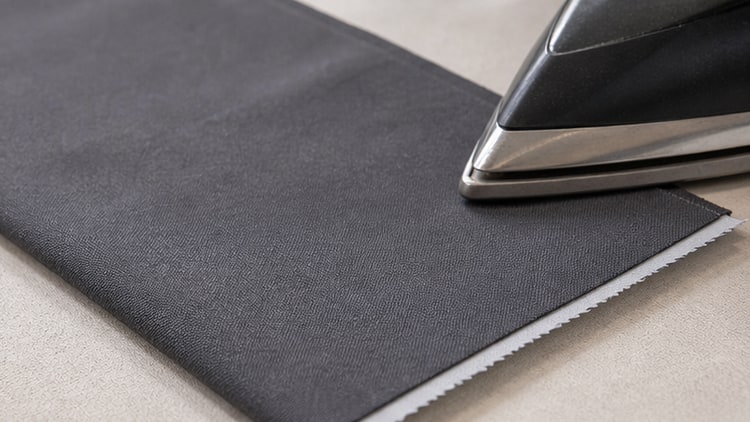
It is safer to recheck samples before approval after washing or dry cleaning them according to actual management conditions. Look for edge lifting, glue show-through, and outer fabric deformation after ironing and steam exposure.
I leave the judgment criteria with a photo.
If you leave the pass/hold criteria as numbers or comparison samples, you can apply the same criteria when reordering. In addition to the appearance, the adhesive stability when pulled by hand and the silhouette after sewing are also recorded.
Practical checklist
- Record the product number, lot, and storage date of the sample.
- Fix the standard press temperature, pressure, and time.
- Compare the adhesion status before and after exposure to high temperature and humidity.
- Check for edge lifting after washing or maintenance testing.
- Approval results and photos are kept in the reproduction standard.
Related products and consultation
Share shell-fabric swatches together with production and storage conditions to compare suitable fusible interlining options. Detailed consultation is available through the contact page.
FAQ
Is time-lapse testing necessary even with a short sample schedule?
Long-term testing is not necessary in all cases, but if there is a possibility of high-temperature transportation, repeated washing, or long-term storage, a simple comparison is recommended.
If the adhesive strength is weak, can I just raise the temperature?
If you raise the temperature unconditionally, the gloss of the outer material and the adhesive may show through. You need to check the combination of interlining and outer material, pressure, and even time.