Garment padding is often compressed to reduce shipping volume, but thickness measured immediately after opening cannot distinguish temporary compression from permanent set. Cutting material before it has recovered can also create uneven garment volume and insulation. Package information, conditioning time after opening, position-based thickness and actual assembly results should be evaluated under one controlled method.
Record compression ratio and packing duration at receipt
The same padding can recover at different rates depending on compressed height, vacuum level, packing date and stacking direction. Record original roll diameter or reference thickness, packed dimensions, packing date, arrival date and storage temperature and humidity. If data are unavailable, compare appearance and weight with an uncompressed approved sample to narrow down the possibility of permanent damage.
Apply a standard conditioning period after opening
Leaving padding folded after opening delays air recovery in the inner layers. Spread it without tension on a clean, flat support and condition it for the specified time under the same temperature and humidity. Thickness records taken immediately after opening, at an intermediate point and at the final point reveal the recovery curve and make lot comparisons more reliable.
Measure center, edge and fold zones separately
Roll centers and inner layers of a compressed bundle remain under pressure longer, while corners and strap-contact zones can retain linear dents. Define equal measurement areas at the center, both edges, beginning, end and folds, using a thickness method that does not add uncontrolled compression. Record minimum values and positional variation as well as the average so risky areas can be excluded from marker placement.
Compare weight and thickness to distinguish causes
When thickness is low but weight per area matches the standard and recovers over time, temporary compression is likely. Low weight as well as low thickness points toward feed variation or thin zones; normal weight with stalled recovery suggests fiber set or bonding damage. Reading both values reduces unnecessary replacement with a heavier material.
Do not force recovery with uncontrolled heat or steam
Uncontrolled high-temperature steam or drying heat used to improve an inspection result can cause fiber shrinkage, binder change and localized clumping. Apply temperature, distance and time only when a recovery condition is specified by the supplier, and record assisted recovery separately from natural recovery. Retaining before-and-after specimens helps trace volume changes seen after sewing.
Connect transport and storage conditions to garment trials
During long sea transport and warehouse stacking, compression duration interacts with temperature and humidity. For garment padding material supplied through a Korea and Vietnam network to the UAE, Saudi Arabia or Qatar, agree with the padding material supplier on actual container temperature, stack height and post-opening wait time rather than relying on regional labels. After recovery approval, quilt the material with the actual shell and lining to check local volume and movement.
Practical checklist
- Record packing date, compressed dimensions, arrival date and storage conditions.
- Spread the material without tension and condition it for the standard period.
- Measure center, edge, fold and strap-contact thickness separately.
- Compare weight per area with the thickness-recovery curve.
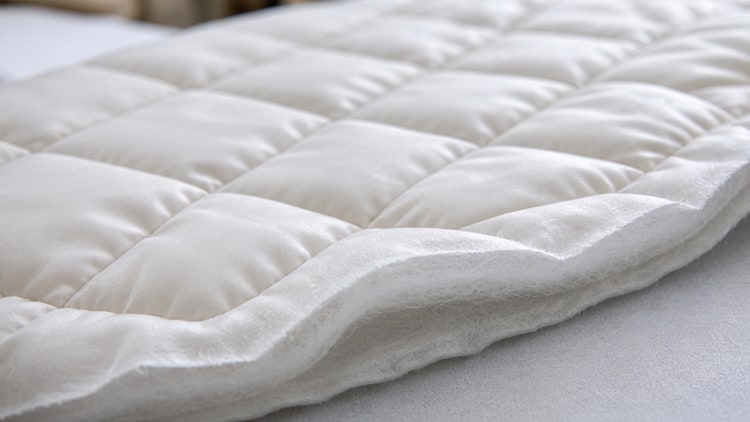
- After approval, evaluate a quilted assembly with the actual shell and lining.
Related products and consultation
Weight and target loft for padding material should be selected by reviewing compression recovery together with the actual quilting interval. Finished-garment drape is also affected by the lining fabric and shell combination. Share packing method, transport duration, target thickness and care conditions through contact.
FAQ
Should compressed padding be measured immediately after opening?
It can be recorded as the initial value, but it should not be the only final acceptance value. Compare it with the recovered value after the specified conditioning period and with positional variation.
If thickness recovers, are all compression-packing risks resolved?
No. Fold marks, bond damage, local clumping and uneven volume after quilting may remain. Appearance, weight, positional thickness and the actual assembly should all be checked.